
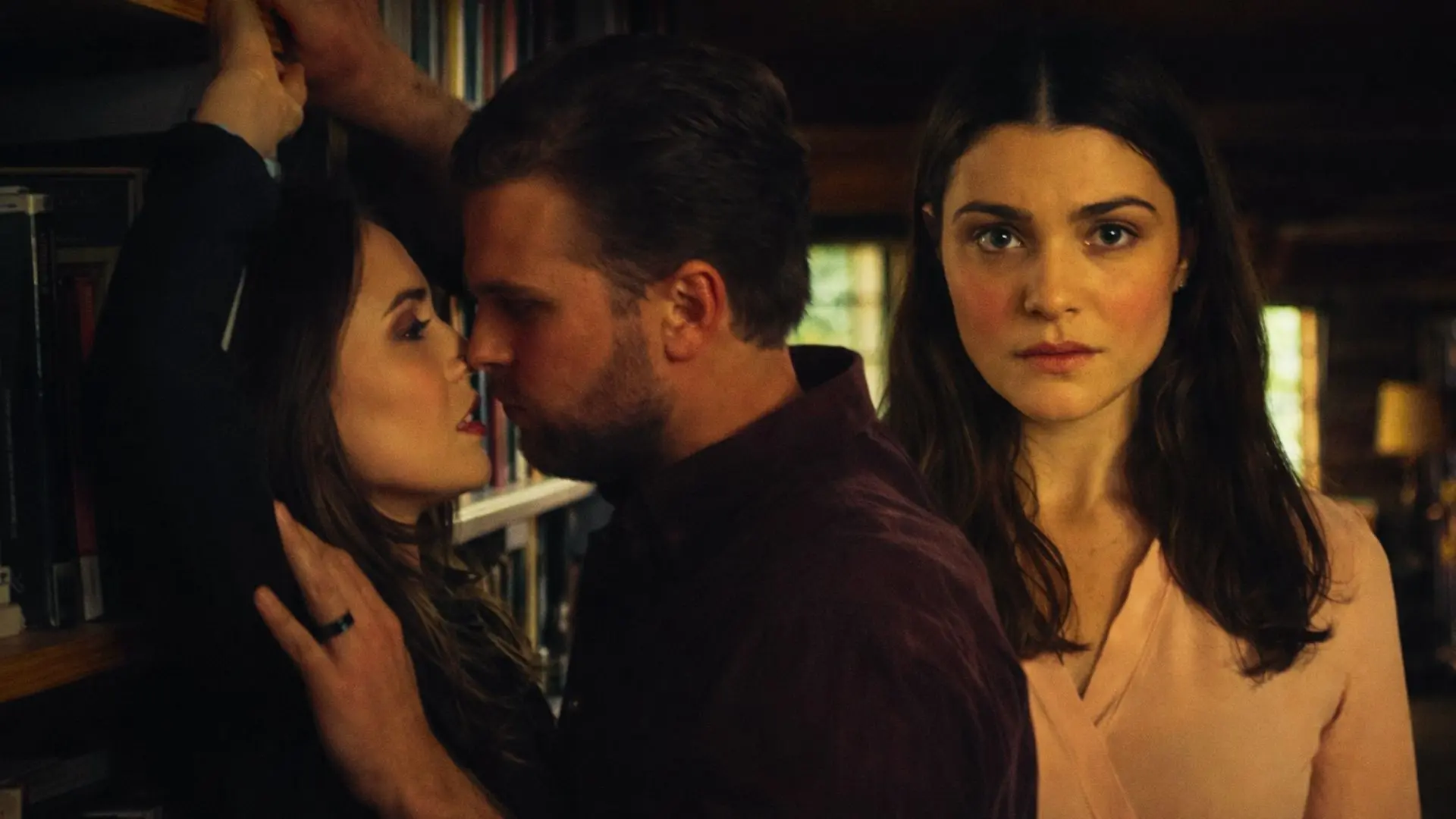
Vladimir Series Review – The Netflix drama Vladimir delivers a provocative and psychologically layered story anchored by a remarkable performance from Rachel Weisz. Adapted from the novel by Julia May Jonas, the series explores obsession, desire, power, and personal delusion within the environment of an elite academic campus.
Starring Leo Woodall, John Slattery, and Jessica Henwick, the show mixes dark humor with psychological drama, creating a story that is both unsettling and intellectually engaging.
Vladimir Series Overview
| Category | Details |
| Title | Vladimir |
| Platform | Netflix |
| Premiere Date | March 5 |
| Creator | Julia May Jonas |
| Main Cast | Rachel Weisz, Leo Woodall, John Slattery, Jessica Henwick |
| Episodes | 8 (Half-hour chapters) |
| Genre | Psychological Drama / Dark Comedy |
Vladimir Series Review – A Complex Story About Desire and Control
At the center of Vladimir is an unnamed creative writing professor played by Rachel Weisz. She finds herself caught in a complicated emotional triangle involving her husband and a younger colleague.

Her husband John (played by John Slattery) is a former head of the English department who becomes embroiled in a scandal. Several former students accuse him of inappropriate relationships during their time at the university. While he argues that the relationships were consensual and took place between adults, the accusations spark a campus controversy.
As disciplinary proceedings begin to unfold, the professor publicly supports her husband—at least in theory. Yet internally she begins to spiral into a different kind of emotional turmoil.
The Arrival of Vladimir
The turning point comes with the arrival of Vlad, a charismatic young writer played by Leo Woodall. He joins the faculty alongside his wife Cynthia (Jessica Henwick).
What begins as a mild fascination soon turns into an intense obsession. Over the course of several weeks, the protagonist becomes increasingly fixated on Vlad, projecting her own fantasies and insecurities onto him.
The series opens with a startling image that hints at how far things will go: Vlad tied unconscious to a chair while the narrator reflects on the strange chain of events that led to that moment.
Rachel Weisz’s Compelling Antiheroine
Rachel Weisz delivers a performance filled with contradictions. Her character appears polished and confident on the outside, but internally she is:
- Self-deluding
- Judgmental
- Emotionally reckless
- Desperate for validation
She frequently insists she would never cross certain moral lines—even as her actions gradually contradict those claims.
At the same time, her wit makes the character strangely captivating. She delivers sharp and sarcastic observations, including memorable lines such as:
“As George Bernard Shaw once said, a firm ass is wasted on the young.”
These moments highlight the show’s blend of intellectual humor and psychological darkness.
A Story Told Through a Narrow Perspective
One of the most distinctive aspects of the series is its intentionally limited point of view.
Almost everything is filtered through the protagonist’s inner monologue. As a result:
- Other characters remain somewhat mysterious
- Their true motivations are never fully revealed
- The audience is trapped inside her increasingly unstable mindset
This storytelling approach can feel claustrophobic at times, but it also adds to the psychological tension.
Obsession Takes Over
As her fixation deepens, the professor begins neglecting major aspects of her life:
- Her strained relationship with her adult daughter Sid (Ellen Robertson)
- Her responsibilities at the university
- Her marriage to John during his moment of crisis
Instead, she pours her energy into analyzing every small detail about Vlad—from his body language to the way he speaks.
At the same time, she channels these feelings into writing the first draft of her long-delayed second novel, blurring the line between artistic inspiration and emotional instability.
Themes Explored in the Series
Vladimir is not just a story about a romantic obsession. It also explores several deeper themes:
- Power dynamics in academia
- Cancel-culture debates on college campuses
- Grief, identity, and midlife crisis
- The psychology of desire and projection
Rather than presenting simple moral judgments, the series focuses on psychological exploration, examining how people justify their behavior and reshape reality to suit their narratives.
A Dark and Unconventional Ending
The story ultimately suggests that desire is not necessarily about connecting with another person. Instead, it often reflects a person’s internal struggles and self-perception.
Read also- Missing: Dead or Alive? Season 3 – Renewal Status, Release Date Speculation & Case Updates
The series concludes with a bold ending that shifts direction from the novel’s conclusion. While the final moments may feel abrupt, they reinforce the central theme: obsession often says more about the person experiencing it than the person they desire.
Final Thoughts
Vladimir stands out as an unusual psychological drama that refuses to offer easy answers. Anchored by Rachel Weisz’s fearless performance and Julia May Jonas’ sharp writing, the series explores the darker corners of human desire and self-deception.
Read also- The Beast in Me Season 2 Cast & Rumours
It may not always be comfortable viewing, but its honesty and psychological depth make it a compelling watch—especially for audiences interested in character-driven dramas that challenge conventional storytelling.