
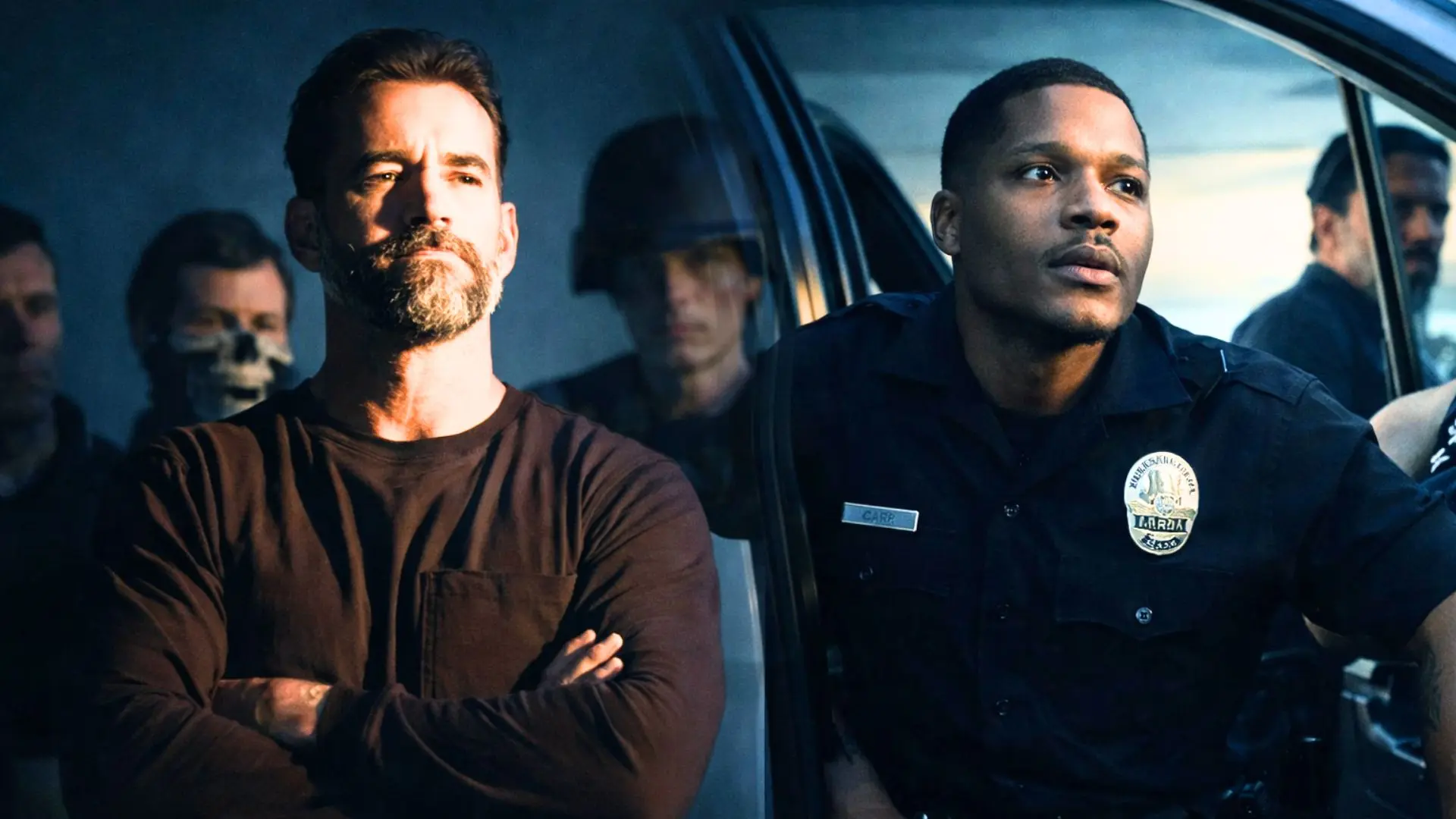
“Night Patrol review” doesn’t nibble at metaphor — it sinks its teeth straight into it. Ryan Prows’ snarling cop-corruption vampire hybrid feels like the kind of movie that dares you to be uncomfortable, then dares you again for enjoying it anyway. It opens up a world where the phrase “capitalist bloodsuckers” isn’t just political rhetoric, it’s job description, and somehow that joke lands harder than most earnest prestige dramas manage in ten episodes.
At the center of the mess is Ethan Hawkins, played by Justin Long with a mix of eager puppy energy and quietly rotting ambition. He’s the son of a legendary LAPD officer, the kind of man whose shadow feels heavier than his badge, and Ethan wants into The Night Patrol — a secret, unofficial elite unit that’s basically a vampire street gang with police uniforms. The movie never lets you forget how seductive that pitch is: power, belonging, immunity, and a moral shortcut that comes pre-approved by the institution itself.
Ethan’s partner, Xavier Carr (Jermaine Fowler), is a much thornier presence. A former Crips member turned patrolman, he’s trying to outrun his past while simultaneously erasing it. Fowler plays him with a brittle smile and a simmering self-disgust that keeps leaking through the cracks. Xavier wants rank, respect, and distance from the chaos he grew up in — but the film keeps asking whether that climb is just another kind of betrayal. When Ethan jokes, “What is that, the Crip version of rebelling against your parents?” it lands like a laugh line and a dagger at the same time.
The family Xavier is running from refuses to stay offscreen. His younger brother Wazi (RJ Cyler) is a jittery, barely-holding-it-together petty criminal who witnesses an LAPD officer murder someone close to him. Suddenly he’s sleeping on a bare mattress at his mama’s house, terrified that The Night Patrol will erase him before he ever gets a chance to talk. That mama, Ayanda Carr (Nicki Micheaux), is the film’s spiritual wildcard: a mystic, a local historian, and a former revolutionary’s widow who never stopped believing the system was a rigged game. She’s plugged into an underground network that hunts monsters posing as influential humans — a detail that sounds pulpy until you realize the movie isn’t sure where the metaphor ends and the literal bloodsucking begins.
Read also- Erykah Badu Announces First Australian Shows in Over a Decade
Prows stages one of the film’s most telling early scenes in a high school gym, where Ethan tells a group of students, “In the media and movies, we’re seen in a very specific light, often a negative light… there are a few bad apples out there. But I’m here to tell you that most of us are good. We’re good apples.” It’s corporate-speak optimism delivered with a straight face, and the camera quietly notes that the only visibly unconvinced student in the room is also the only Black one. Then the doors burst open, a masked gunman fires an Uzi into the ceiling, and demands that same student kneel and suck his own finger. The reveal that it’s Xavier pulling a prank with blanks should be comic relief, but it curdles into something uglier — a joke that exposes just how far he’s drifted from whatever moral center he thought he still had.
Read also- Netflix Spotlights Comedy as Matt Rife and Friends Take Centre Stage
That rot runs through the film’s DNA. The cops in “Night Patrol” don’t feel like part of the communities they patrol; they feel like an occupying force with better lighting and worse impulse control. Ethan and Xavier bond over adrenaline rushes — chases, confrontations, the tiny privileges of the job — like grabbing instant tacos without paying because Ethan chats up the cook in Spanish and the system just… lets them. They commit acts that should haunt them and then, five minutes later, they’re trading dumb jokes like nothing stuck. Guilt exists here, but only in brief flashes, like a notification you swipe away without reading.
Dermot Mulroney’s presence as Ethan’s late father hangs over everything, a ghost of bulldozing moral certainty and old-school brutality that explains a lot about why Ethan mistakes violence for righteousness. Meanwhile Ayanda tells her sons they’ve both disappointed her — Xavier for becoming a cop, Wazi for staying a criminal — and makes it painfully clear that what she’s never stopped loving most is sticking it to The Man. Nobody in this movie escapes their origin story; they just remix it into something more socially acceptable.
The script, co-written by Prows with Shaye Ogbonna, Tim Cairo, and Jake Gibson, sometimes overreaches. The numbered chapter titles feel like a leftover Tarantino cosplay impulse, and some of the supporting performances wobble hard enough to pull you out of the spell. The first two-thirds juggle parallel storylines like they’re warming up for a grand convergence, and when the big shootout finally arrives, it’s slick and loud but not as mythically charged as all that setup promises. You can feel the movie straining to become a full-blown cult epic instead of a very smart midnight thriller.
And yet, it works more often than it should. Benjamin Kitten’s grainy widescreen cinematography and Pepijn Caudron’s buzzing, growling synth score make the whole thing feel like a lost ’80s VHS classic that somehow absorbed Twitter discourse. There’s a whiff of John Carpenter in the atmosphere, a dash of Romero in the social critique, and a boldness that recalls how Wes Craven used monsters to talk about the real ones. The vampires aren’t just villains; they’re a system wearing fangs, and the cops aren’t heroes; they’re aspirational recruits to a blood economy that already runs the world.
What lingers is the sense that this universe existed before we dropped in and will keep grinding on after the credits roll. Even the characters who seem like pure antagonists get moments of complexity, little human cracks that make their monstrosity feel earned rather than decorative. It’s being sold as trashy escapism, but it plays more like a Trojan horse political film — the kind you’d pair with “Near Dark” and “Training Day” on a double bill and accidentally start an argument in your living room.
“Night Patrol” isn’t polished, and it isn’t subtle, but it’s alive in a way most genre mashups aren’t. It’s angry, messy, and weirdly sincere about how soaked in blood the American dream can be. I walked out feeling unsettled, a little exhilarated, and uncomfortably aware that the movie’s monsters didn’t feel nearly as fictional as I wanted them to.