
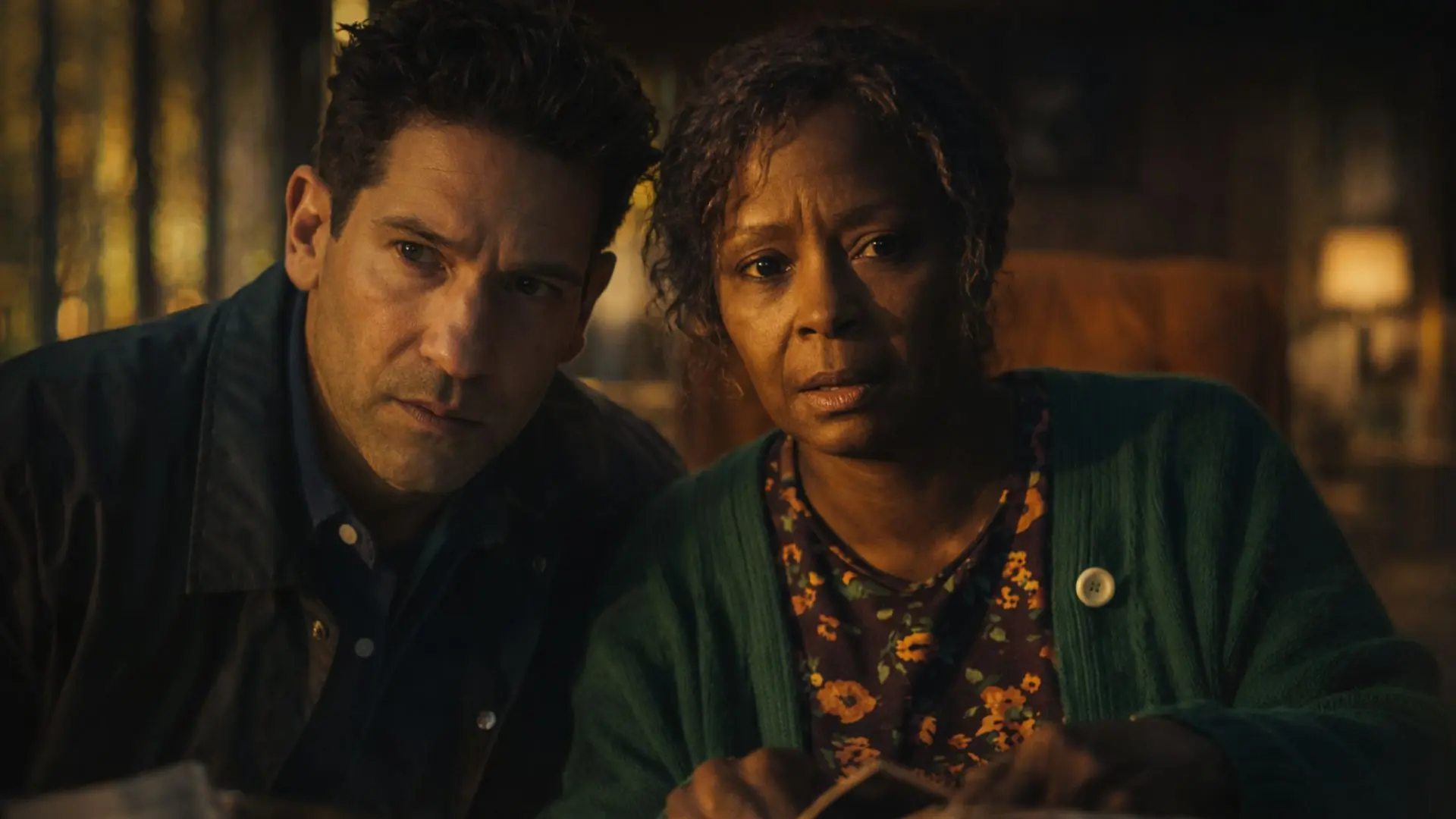
Netflix’s psychological thriller His & Hers has surged into the platform’s global Top 10, quickly becoming one of the most binge-watched new releases — including among Australian viewers. Dark, tense, and deliberately unsettling, the series pulls audiences into a murder mystery that refuses to play fair.
Adapted from Alice Feeney’s bestselling 2020 novel, the six-episode limited series stars Tessa Thompson and Jon Bernthal as estranged spouses forced back into each other’s orbit when a killing connected to their past reopens old wounds. While the show follows the broad framework of the book, Netflix has quietly reworked key details behind the scenes.
Some of those changes are easy to miss. Others significantly alter character motivations, narrative reliability, and the story’s moral balance. Whether you’ve read the novel or are coming to His & Hers for the first time, those differences shape how the mystery ultimately lands.
Below is a spoiler-aware breakdown of the biggest changes between the book and the Netflix series.
A different path back to the newsroom
In the Netflix adaptation, Thompson’s Anna is an Atlanta news anchor who abruptly returns to work after an unofficial year-long absence. She demands her former prime-time slot back, following the death of her young daughter.
Her boss informs her that the position has been provisionally filled by rising star Lexy Jones, played by Rebecca Rittenhouse. Rather than fight the decision, Anna pivots — requesting to be sent into the field to cover the murder of her childhood friend Rachel in her hometown of Dahlonega, Georgia.

The assignment reunites her with her estranged husband, Detective Jack Harper (Bernthal), who happens to be leading the investigation.
In Feeney’s novel, the workplace dynamic plays out quite differently. Lexy is named Cat Jones in the book, and Anna isn’t returning from hiatus. Instead, she has been filling Cat’s anchor role while Cat is on maternity leave. When Cat comes back, it’s she who quietly manoeuvres Anna into covering the Dahlonega murder — a move that feels calculated rather than coincidental.
In both versions, Anna remains unaware that her professional rival is actually Catherine — a girl tied to the darkest night of her teenage years.
Rachel’s husband becomes a real suspect
One of the more obvious changes involves Rachel’s husband.
In the novel, Rachel’s widower is an 82-year-old, wealthy man who is frail, bedridden and quickly dismissed as a suspect due to his age and poor health. Readers never even meet him on the page.
The Netflix series takes a different approach. Rachel’s husband, Clyde (played by Chris Bauer), is significantly younger and physically capable. This shift places him squarely in the suspect pool, widening the show’s sense of danger and misdirection.
It’s a practical television choice — and one that adds another layer of tension to the investigation.
Anna’s alcoholism is dialled down
In the book, Anna’s alcoholism is central to the story’s psychological unease.
Feeney presents her as an unreliable narrator, prone to blackouts and memory gaps that make even Anna question her own actions. Readers are repeatedly warned not to take her version of events at face value.
One key moment sees Anna waking to find her room inexplicably cleaned. She assumes she must have done it herself while drunk — only to later learn her mother, Alice, had quietly tidied up. As the story unfolds, Anna even wonders whether she herself could be the killer, unable to remember because of a massive binge.
Read also – Kayce Dutton’s Full Yellowstone Journey — What to Remember Before Marshals
The Netflix series largely removes this ambiguity. While Anna is shown drinking early on — including downing half a bottle of wine — her alcohol use is never framed as dangerous or disorienting.
By the time the final twist arrives, Anna is portrayed as clear-headed when she reads her mother’s confession letter, changing the emotional weight of the reveal.
The climactic confrontation is completely reworked
The book’s final act is complex, violent and chaotic.
In the novel, Anna is lured to Cat’s parents’ isolated lake house after hearing Richard’s screams. Inside, she finds him gravely injured — stabbed multiple times and suffering a severe head wound. She also discovers Cat hanging from a noose, only to realise Cat has staged her own death to trap her.
Read also – Billy Bob Thornton Says Sam Elliott Is “a Dream Come True” — Inside Their 40-Year Bond
Anna escapes outside and encounters her mother, Alice, who is supposedly suffering from dementia. Jack soon arrives, followed by his partner Priya, who has grown suspicious of him after learning about his affair with Rachel.
What follows is brutal. Cat chases Anna and Alice, stabbing Alice in the process. Anna manages to get her mother into a car and, while fleeing, runs Cat over. Cat survives — briefly — before Priya fatally shoots her as she raises a knife to attack again.
Netflix opts for a leaner, more contained ending.
In the series, Richard brings Anna to his in-laws’ home. After a confrontation, Anna locks him in the basement just as Lexy arrives. Anna and Lexy face off in a prolonged, exhausting struggle. Both are bloodied. Lexy gains control of Anna’s gun.
Priya intervenes and shoots Lexy dead, saving Anna. Alice does not appear in this sequence, and Richard survives, later arrested for helping Lexy.
Who was really attacked — and why it matters
Another crucial shift lies in the story’s emotional core.
In the novel, it’s Cat who was raped at Anna’s 16th birthday — orchestrated by Rachel, Helen Wang and Jack’s sister Zoe. Anna later comes to believe Cat murdered them in revenge.
Read also –Landman Will Return for Season 3 — Details So Far
In the Netflix series, that detail is changed. Anna herself is raped after saving Lexy from the attack, reframing her trauma and altering how viewers interpret her relationships and guilt.
Alice’s confession takes a clearer shape on screen
Both the book and series end with Alice confessing to the murders of Rachel, Helen and Zoe. But her motivation is more straightforward in the show.
In Netflix’s version, Alice reveals she began killing after discovering old footage of Anna’s 16th birthday — footage showing her daughter being raped.
The novel’s ending is more morally tangled. Since Cat was the victim in the book, Alice assumes Anna’s guilt over not intervening drove her to flee Dahlonega. Blaming Rachel, Helen and Zoe for her daughter’s disappearance, Alice kills them and attempts to frame Cat.
A sharper, simpler adaptation
Ultimately, Netflix’s His & Hers trims complexity in favour of clarity. It removes layers of ambiguity, softens Anna’s unreliability and delivers a cleaner resolution for television audiences.
Read also – A Knight of the Seven Kingdoms Review: A Smaller, Sharper Journey Through Westeros
For Australian viewers, the result is a fast-paced, emotionally accessible thriller — one that stands on its own, even as it diverges from its literary roots.
His & Hers is now streaming on Netflix.