
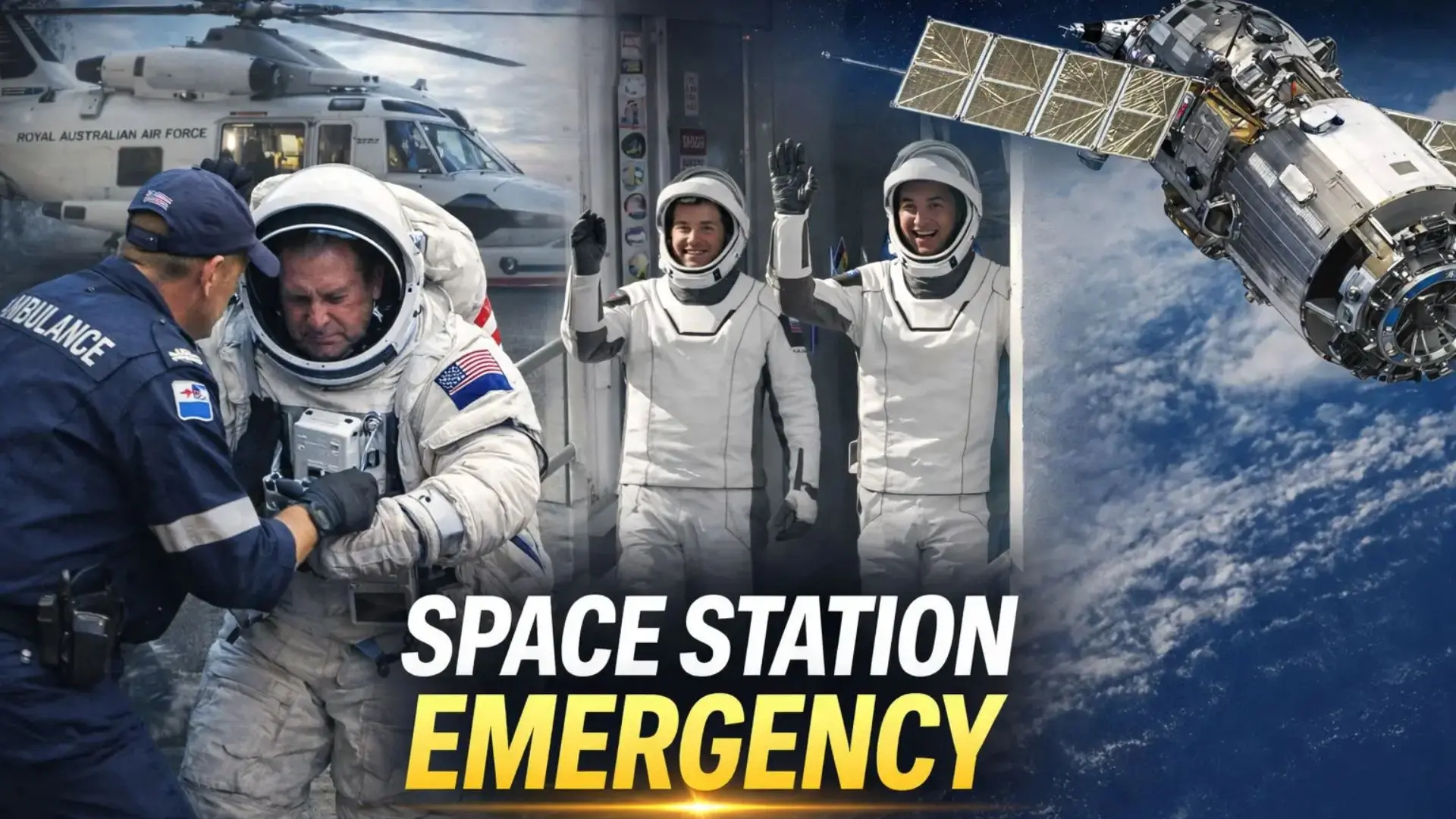
Nasa astronauts space station evacuation : Four astronauts have safely returned to Earth after an unexpected early departure from the International Space Station (ISS) due to a “serious” medical issue, marking a rare event in the station’s 26-year history.
The crew, known as Crew-11, were originally scheduled to spend six and a half months aboard the ISS but cut their mission short by a month. NASA astronaut Mike Fincke, the team’s commander, was the first to exit the spacecraft. He smiled for cameras while wobbling slightly on his feet before lying down on a gurney, following standard post-landing protocols.
Following Fincke, NASA’s Zena Cardman, Japan’s Kimiya Yui, and Russian cosmonaut Oleg Platonov stepped out, waving to media and appearing relieved. “It’s so good to be home!” Cardman said.
This is the first time an astronaut has been evacuated from the ISS due to a health issue since the station began orbiting Earth in 1998. After splashdown off the coast of California, the astronauts will undergo medical evaluations before returning to their home countries.
Nasa astronauts space station evacuation: Health Update
During a press briefing after the landing, NASA administrator Jared Isaacman confirmed that the ill astronaut is “fine right now” and “in good spirits.” Based on previous NASA protocols, the agency is unlikely to reveal the crew member’s identity or details of the health condition.
Control of the ISS has been temporarily handed over to Russian cosmonaut Sergey Kud-Sverchkov, who now leads the remaining crew alongside two other astronauts.
Mission Background
Crew-11 arrived at the ISS on 1 August and were scheduled to return in mid-February. Their early departure followed the abrupt cancellation of a planned spacewalk involving Fincke and Cardman. NASA later announced that a crew member had fallen ill, prompting the evacuation.
“It’s bittersweet,” Fincke said as he formally handed over responsibilities to Kud-Sverchkov. In a social media post, he reassured the public that all crew members aboard the ISS were “stable, safe, and well cared for.”
Life on the Space Station
Orbiting at around 250 miles above Earth and travelling at 17,500 miles per hour, the ISS completes approximately 16 orbits daily. Operated collaboratively by five international space agencies, the station conducts wide-ranging scientific experiments studying space, as well as the effects of microgravity on humans, animals, and plants.
Read also – Chinese Investors Lead Australia’s Foreign Housing Ownership, Fresh ATO Figures Show
Although equipped with some medical supplies and personnel trained for minor health issues, the ISS does not carry a doctor on board. The recent evacuation tested NASA’s emergency procedures for handling serious medical situations in space — a challenge the agency appears to have managed effectively, though questions remain about potential responses to more severe emergencies.
Adjusting to a Smaller Crew
With Crew-11’s early return, the ISS is now operating with a reduced crew of just three astronauts: NASA’s Chris Williams and Russian cosmonauts Kud-Sverchkov and Sergei Mikaev. They will continue performing scientific experiments and maintenance tasks until four new astronauts arrive in February.
Read also – Coffee While Driving in Australia Could Now Cost You Up to $1,100 Under Stricter Road Rules
“Despite all the changes and difficulties, we will continue our work onboard ISS,” Kud-Sverchkov said, announcing his first command with a light-hearted group hug.
A Rare Occurrence in Space History
Early mission terminations due to medical emergencies are extremely uncommon. Prior to this event, only two similar incidents had occurred. In 1985, Soviet cosmonaut Vladimir Vasyutin left Salyut 7 four months early due to a urological problem, and in 1987, cosmonaut Aleksandr Laveykin departed the Mir space station early following a heart arrhythmia.
Read also – Youth Allowance Increase January 2026: $1,011.50 Boost Plus $16.20 Pay Rise
As humanity prepares for more frequent space travel, including commercial tourism and long-term missions to the Moon or Mars, experts emphasise the growing need for medical professionals to accompany crews on future expeditions.
The safe return of Crew-11 highlights both the risks of living in space and the readiness of current procedures to handle medical emergencies, even in one of the most extreme environments humans can endure.