
Is Mother of Flies a family Movie Review ? That question is circulating precisely because the answer depends on how the term is understood. The film follows a father and daughter drawn into the orbit of a faith healer living deep in the woods, but it is not a warm domestic drama. Instead, it unfolds as a grim fable about death, belief, grief, and the vulnerability of the human body, created by the Adams-Poser family, one of the most distinctive collaborative units in American independent cinema.
Interest in the film is growing as horror audiences seek out works that lean into atmosphere and physical unease rather than conventional scares.
Who are the filmmakers behind Mother of Flies?
The film is made by a four-person collective consisting of John Adams, Toby Poser, and their daughters Lulu and Zelda Adams. The group writes, directs, shoots, edits, and performs together, often handling multiple roles simultaneously while appearing on screen.
Their previous films include The Deeper You Dig and Hellbender, both of which established their reputation for intensely personal, self-contained horror projects. Mother of Flies continues that pattern, presenting a work that feels unified in vision and execution, shaped by a shared creative instinct rather than a conventional production structure.
Why does the opening sequence unsettle viewers so quickly?
The opening credits of Mother of Flies establish its tone through imagery that is deliberately hard to interpret. Blood, mud, slime, and other organic matter fill the frame, with textures that suggest both ancient roots and mass death. A naked body, coated in gore, moves rhythmically in tight framing that blurs the line between pain, pleasure, birth, and decay.
The imagery recalls the work of painters known for their visions of damnation and bodily suffering, including Hieronymus Bosch, Francisco Goya, and Jusepe de Ribera. At this stage, the images function less as narrative information and more as a sensory warning of what lies ahead.
What story does Mother of Flies actually tell?
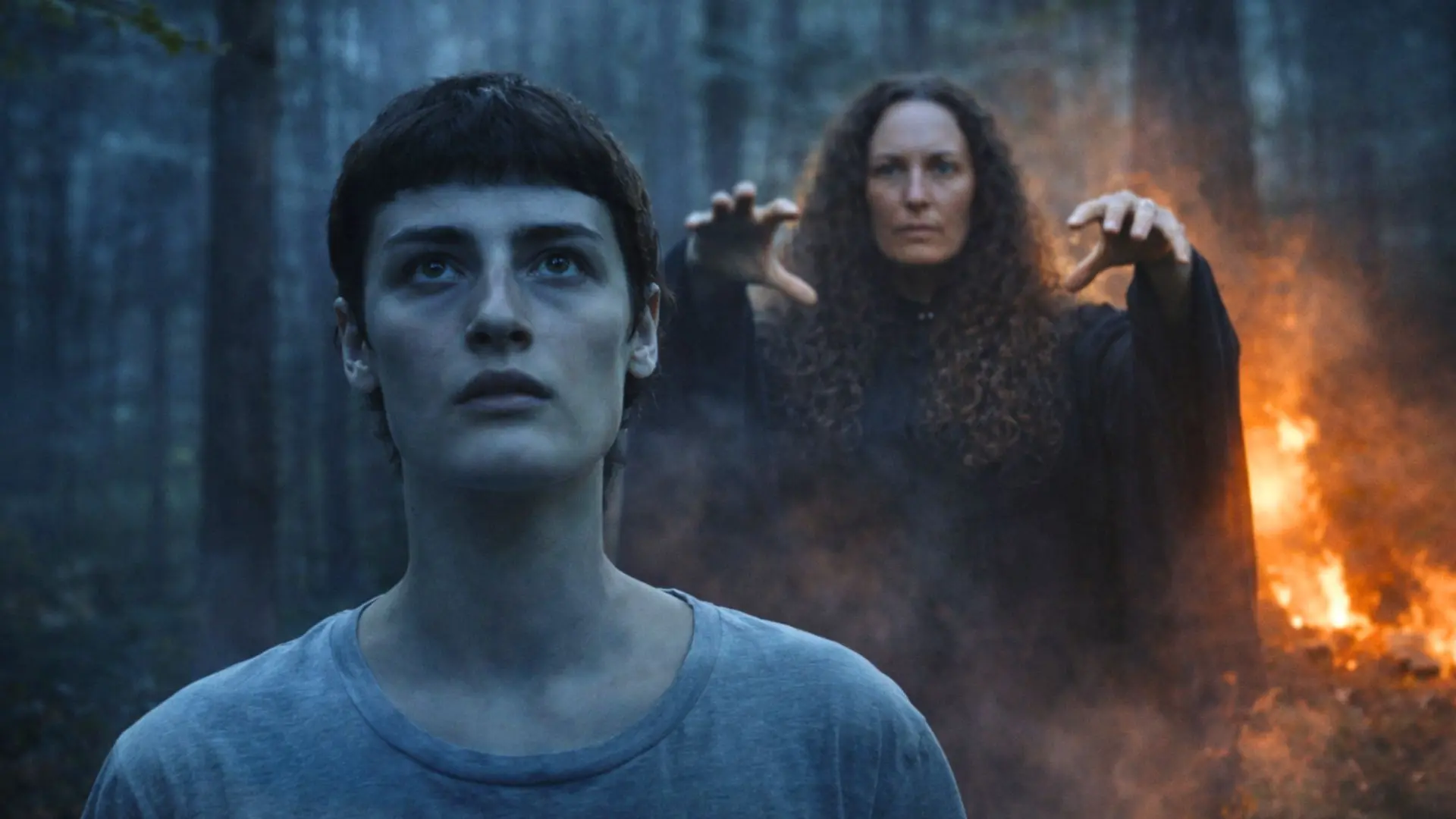
The meaning of those early images becomes clearer as the film follows Mickey, played by Zelda Adams, and her father Jake, played by John Adams. The pair travel to an isolated woodland house to meet Solvieg, portrayed by Toby Poser, a healer whose reputation extends beyond conventional medicine.
Mickey is dying from cancer and has exhausted all available treatments. Solvieg is presented immediately as a mystic figure, someone whose methods exist outside modern science. The audience understands her nature before the characters fully do, creating an underlying sense of dread as the meeting unfolds.
Who is Solvieg, and why does she dominate the film?
Solvieg speaks in dense, indirect language. Her dialogue takes the form of monologues, incantations, and scripture-like recitations, often drawing on poetic rhythms that echo 19th-century English verse. Meaning is not always clear, and communication feels intentionally obstructed.
Despite this, Solvieg exudes absolute confidence in her abilities. She demands total submission to her process, which rejects technology and modern comforts entirely. Food consists of foraged plants and mushrooms. There are no toilets, forcing the visitors to live as their ancestors once did. The dynamic resembles an extreme belief system led by a single authority figure, with no room for negotiation.
How does the film use its setting to build tension?
The woodland location is integral to the film’s impact. Solvieg’s house is engulfed by vines, so heavily overgrown that its structure is barely distinguishable from the surrounding forest. Nature appears to be reclaiming the space, blurring the boundary between shelter and wilderness.
Read also- Carousel Festival Movie Review : A Sundance Love Story That Almost Breaks Your Heart
Solvieg is rarely framed casually. She enters scenes through doorways, shadows, and tree lines, often partially obscured or backlit. This visual strategy reinforces her power and mystery. Meanwhile, Mickey begins to experience disturbing visions that may be hallucinations or something else entirely. In one recurring image, a fleshy, shifting form opens in the ceiling above her bed, resembling an orifice that continually changes shape.
Why are flies so central to the film?
As the title promises, flies are everywhere. Swarms appear repeatedly, becoming a visual and symbolic motif. The film’s use of insects places it alongside earlier horror works known for similar imagery, including Exorcist II: The Heretic and the original The Amityville Horror.
Read also- Ha-chan Shake Your Booty!’ Movie Review: Rinko Kikuchi Turns Grief Into a Dance-Floor Delight
As the story progresses, the violence escalates. Some scenes evoke the extreme and sensational accounts associated with moral panics in the United States during the 1980s and 1990s, involving ritual abuse, bodily mutilation, and acts committed against pregnant women. These moments are presented without restraint, reinforcing the film’s commitment to physical horror.
Is the film more style than substance?
Every shot in Mother of Flies is carefully constructed. The images are detailed, deliberate, and visually striking, standing in contrast to more casual contemporary filmmaking that prioritises performance over composition.
Read also- Return to Silent Hill Movie Review : Is the Long-Awaited Sequel Worth Revisiting the Town?
At times, however, the emphasis on imagery slows the film unevenly. The pacing occupies an uncomfortable middle ground, neither slow enough to induce a trance-like effect nor brisk enough to maintain consistent momentum. While many horror films move more slowly and still sustain tension, Mother of Flies occasionally feels fragmented, as if its individual elements are competing rather than merging.
Why does the film still resonate with horror fans?
Despite these issues, the film offers significant rewards. For viewers drawn to atmospheric, gore-driven horror that relies on dread rather than sudden shocks, Mother of Flies delivers a distinctive experience. The performances anchor the film, remaining grounded and unforced even as the world around the characters becomes increasingly unreal.
The forest itself emerges as a quiet but powerful presence, reinforcing the film’s themes of decay, transformation, and inevitability. Mother of Flies may not envelop viewers completely, but it leaves a lasting impression, inviting repeated examination rather than passive consumption.