
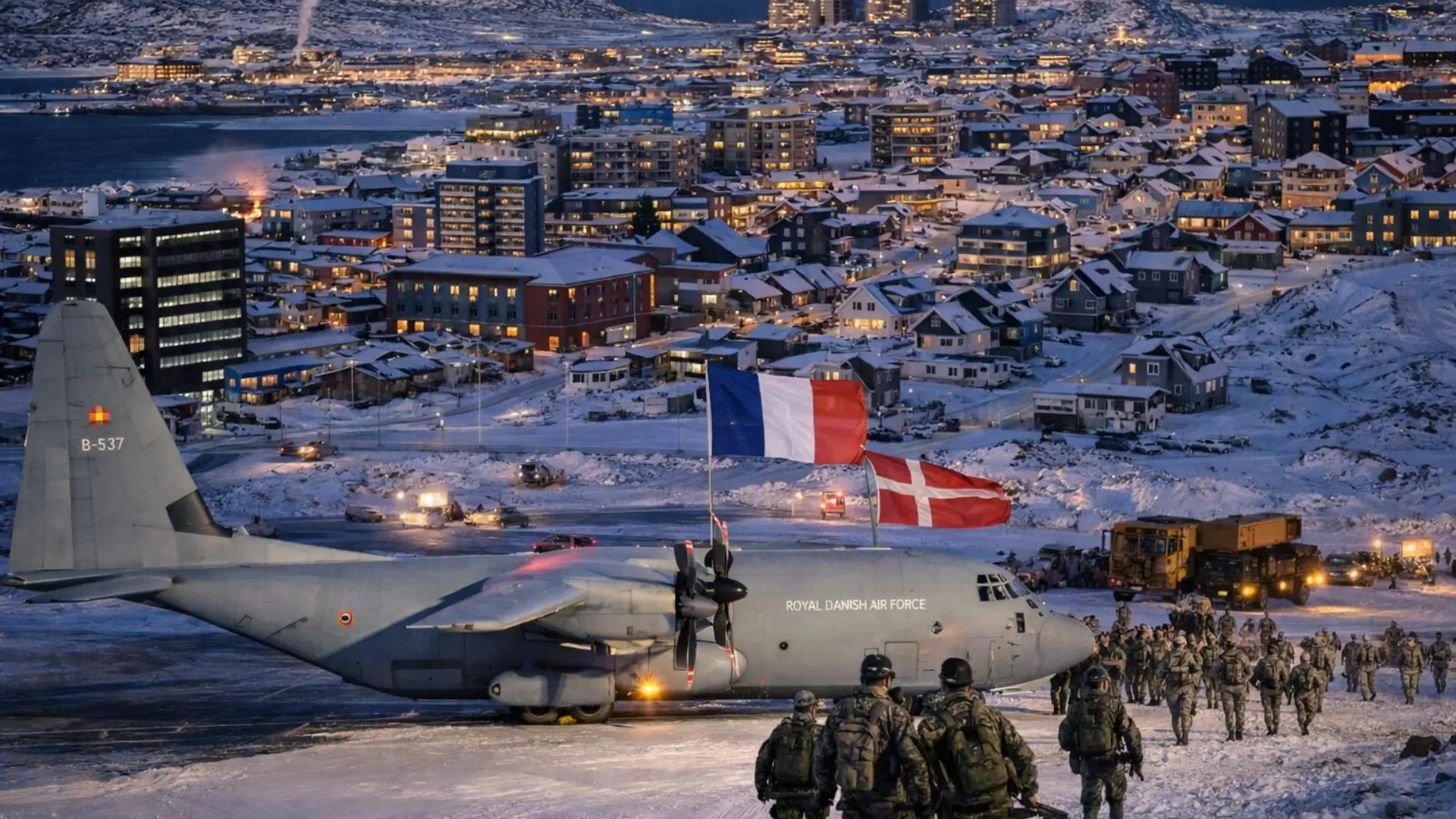
European military forces have begun a symbolic deployment to Greenland, signalling growing tension inside NATO as US President Donald Trump renews his push to bring the Arctic territory under American control.
While the number of troops involved is small, the political message is large — and closely watched by allies, including Australia, as the Arctic becomes an increasingly sensitive global flashpoint.
Small European Deployment Lands in Nuuk
A small French military contingent has arrived in Nuuk, Greenland’s capital, according to officials, marking the first visible step in a wider European reconnaissance mission.
The deployment includes personnel from France, Germany, Sweden, Norway, Finland, the Netherlands and the United Kingdom. It is being carried out under Danish leadership as part of joint exercises known as Operation Arctic Endurance.
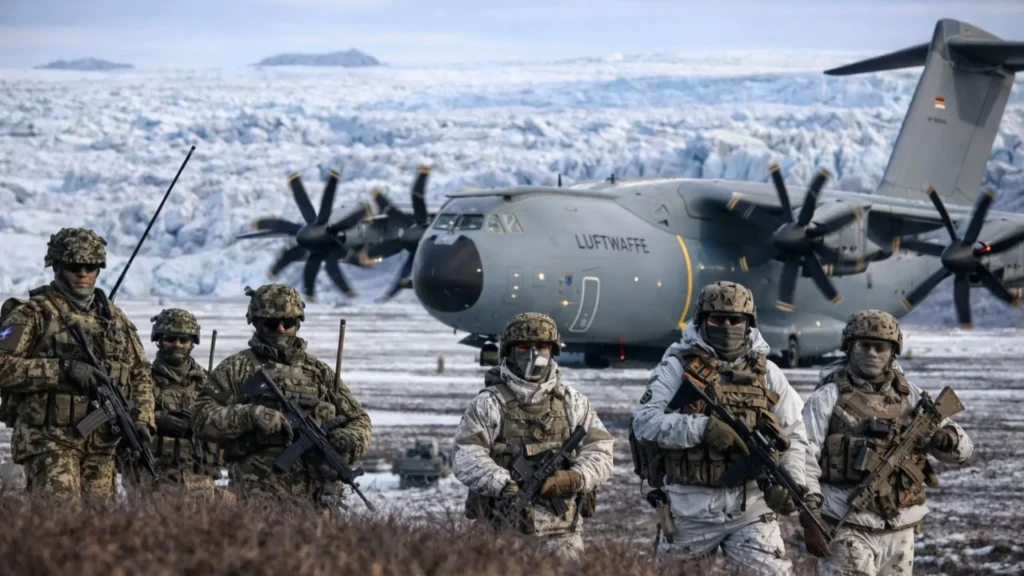
French President Emmanuel Macron confirmed the initial group would soon be strengthened with additional land, air and sea assets, underscoring Europe’s intent to demonstrate a collective security presence in the Arctic.
Senior French diplomat Olivier Poivre d’Arvor described the move as deliberately political.
“This is my first exercise,” he said. “We’ll show the US that NATO is present.”
The French contribution currently stands at just 15 personnel, highlighting the symbolic nature of the operation rather than any immediate military escalation.
Deployment Comes as US Presses Greenland Claim
The timing of the European move is significant. It comes as President Trump continues to argue that Greenland is vital to US national security.
Speaking to reporters in the Oval Office, Trump said bluntly: “We need Greenland for national security.”
While he stopped short of explicitly threatening force, he did not rule it out and suggested the issue could be resolved with Denmark. He also questioned Denmark’s ability to defend Greenland against external threats.
“The problem is there’s not a thing that Denmark can do about it if Russia or China wants to occupy Greenland,” Trump said. “But there’s everything we can do.”
Those comments have unsettled European capitals and raised concerns within NATO about unity between alliance members.
Denmark Pushes Back After Washington Talks
The European deployment followed high-level talks in Washington between Denmark’s Foreign Minister Lars Løkke Rasmussen, Greenland’s foreign minister, US Vice-President JD Vance, and Secretary of State Marco Rubio.
Rasmussen described the discussions as constructive but admitted there was a “fundamental disagreement” between the two sides.
He later criticised Trump’s renewed bid to buy or acquire Greenland, pushing back against the US security justification.
“There is no instant threat from China or Russia that Denmark and Greenland cannot manage,” Rasmussen said, while acknowledging some shared security concerns with Washington.
He was clear on one point: Greenland is not for sale.
“This is 2026,” he told Fox News. “You trade with people, but you don’t trade people.”
White House Downplays European Response
Despite the growing diplomatic unease, the White House has played down the European military move.
Press Secretary Karoline Leavitt said the deployment would not affect President Trump’s stance.
“Nor does it impact his goal of the acquisition of Greenland at all,” she said.
The comments underline the depth of disagreement inside NATO, with allies publicly signalling unity while privately managing sharp strategic differences.
Other NATO Voices Raise Alarm
Poland, a key NATO member, has declined to join the Greenland deployment but issued a stark warning.
Prime Minister Donald Tusk said any US military intervention would be “a political disaster”.
“A conflict or attempted annexation of the territory of a NATO member by another NATO member would be the end of the world as we know it,” he said, warning it would undermine decades of collective security.
Russia, meanwhile, has seized on the developments. Its embassy in Belgium expressed “serious concern”, accusing NATO of expanding its Arctic military footprint under what it called a false pretext of threats from Moscow and Beijing.
What the Military Mission Involves
Despite the heightened rhetoric, the actual scale of the operation remains modest.
The European presence totals only a few dozen personnel, and officials have not confirmed how long they will remain in Greenland.
Read also – New UK Passport Rules Leave Australians Facing Missed Family Moments and Cancelled Trips
Finland has sent two military liaison officers for what it describes as a fact-finding mission during the planning stage of Operation Arctic Endurance.
“We are not ruling anything out, but we are not specifically considering anything,” said Janne Kuusela, head of policy at Finland’s defence ministry.
Germany has dispatched an A400M transport aircraft to Nuuk carrying 13 soldiers, though officials confirmed the contingent will stay only until Saturday.
Denmark Seeks Ongoing NATO Presence
Danish defence officials say the decision to increase military activity around Greenland was made jointly with the Greenlandic government.
Read also – ISS SOS call; astronaut leaves space station, Reason: lack of medical resources
The aim is to strengthen NATO’s “footprint in the Arctic for the benefit of both European and transatlantic security”.
Danish Defence Minister Troels Lund Poulsen said the longer-term goal is a rotating military presence, with allied forces participating in training and exercises on the island.
Macron echoed that sentiment in his New Year address to France’s armed forces, saying Europe has a special responsibility to Greenland because it is both part of the European Union and a NATO ally.
Greenland Rejects US Control
For Greenland itself, the situation has become increasingly tense.
Read also – The Rip story review – The Rip Delivers a Glossy Netflix Thriller With Affleck and Damon
Prime Minister Jens-Frederik Nielsen said the territory is facing a geopolitical crisis and made its position clear.
“Greenland does not want to be owned by the United States. Greenland does not want to be governed by the United States. Greenland does not want to be part of the United States,” he said.
He added that if Greenlanders were forced to choose, they would side with Denmark.
Why This Matters Beyond Europe
For Australia and other US allies, the Greenland standoff is more than a distant Arctic dispute.
It raises serious questions about alliance cohesion, respect for sovereignty, and how security claims are used in strategic regions — themes that resonate across the Indo-Pacific as well as the Arctic.
Read also – AST SpaceMobile Stock Soars on Major Government Contract Announcement
As global competition intensifies, Greenland has become a test case for how far power politics can stretch inside long-standing alliances — and how smaller nations protect their autonomy when strategic interests collide.