

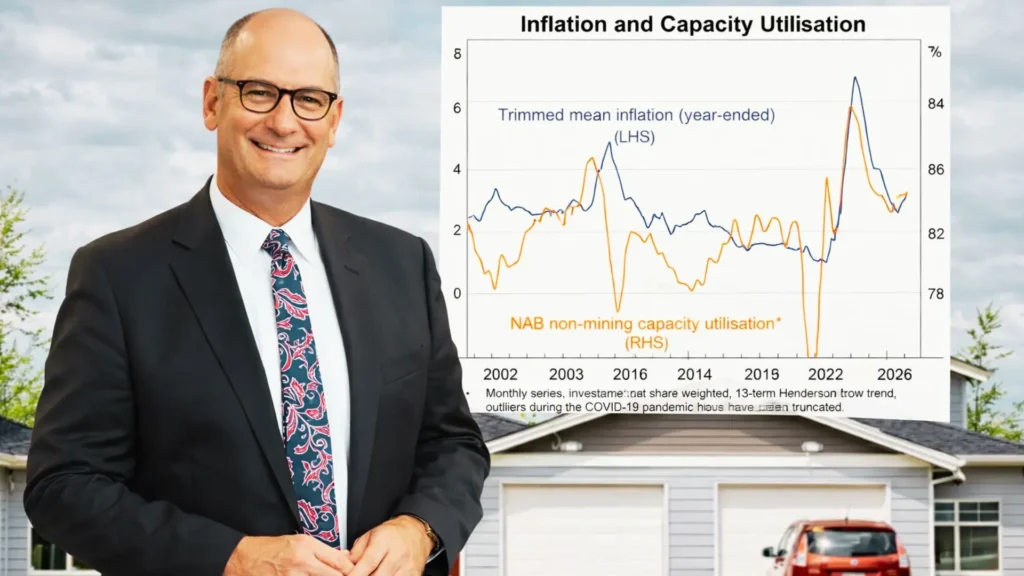
Australian Inflation Rate 2026 continues to remain uncomfortably high, with rising housing and electricity costs standing out as the main pressure points for households. The latest January Consumer Price Index (CPI) data released by the Australian Bureau of Statistics shows headline inflation holding steady at 3.8 per cent, while the trimmed mean edged slightly higher to 3.4 per cent, up from 3.3 per cent in December, indicating that underlying inflation pressures have yet to ease.
While the overall number may appear stable, one category in particular is triggering serious concern—housing.
Australian Inflation Rate 2026 – Housing Costs Drive Australia’s Inflation Surge
Housing inflation surged 6.8 per cent year on year, a sharp jump from 5.5 per cent in December and 5.2 per cent in November. Given housing is the largest component of the CPI basket, the rise suggests inflationary pressures are becoming increasingly entrenched.
Housing carries a 21.4 per cent weighting in the CPI, meaning it contributed 1.4476 percentage points to the total 3.8 per cent inflation rate—more than one-third of the overall figure. This marks a dramatic shift compared to June last year, when housing contributed just 0.3346 percentage points.
Food and non-alcoholic beverages, the second-largest CPI category with a 17.4 per cent weighting, recorded inflation of 3.1 per cent, remaining below the overall CPI rate. Other major categories—including recreation and culture, transport, and household furnishings and services—also came in under the headline figure.
Electricity Costs Fuel the Housing Inflation Surge
For several months now, housing has been the dominant driver of inflation. Within the CPI, housing includes construction costs, rents, and electricity—and it is electricity prices that have risen most dramatically.
Electricity costs jumped 32.2 per cent in the 12 months to January 2026, accelerating from 21.5 per cent in December 2025. The sharp rise has largely been attributed to Commonwealth and state government electricity rebates gradually being withdrawn.
SQM Research managing director Louis Christopher said electricity had become the single biggest contributor to inflation within the housing category.
“Electricity within housing was the largest contributor to inflation, largely due to the roll-off of rebates,” he explained, adding that rebates in Queensland and Western Australia were still in place in January and are yet to fully unwind.
Rents and Construction Costs Add Further Pressure
New dwelling prices increased 3.5 per cent, while rents continue to rise at an alarming pace. Rental inflation climbed 3.9 per cent, making it the second-largest contributor to housing inflation.
Read also- Australia’s State Pension Pivot : Is 67 Still the Retirement Benchmark?
Christopher warned that interest rate hikes may actually worsen rental inflation. With vacancy rates sitting in the low-to-mid one per cent range, Australia’s rental market remains extremely tight.
“In this environment, landlords are able to pass on higher costs to tenants,” he said. “Raising rates can put upward pressure on rents—and so the vicious cycle continues.”
Rate Hikes Still on the Table
Meanwhile, Compare the Market economic director David Koch said inflation now appears “baked in,” warning homeowners to brace for the possibility of further interest rate rises later this year.
Read also- Goodbye to Automatic Licence Renewals 2026: New Rules for Senior Drivers
“I think the Reserve Bank of Australia will wait for the next quarter’s inflation data to assess whether the most recent rate increase has had an impact,” he said. “A move in March would have a major psychological effect and come as a shock to consumers.”
With housing and electricity costs continuing to surge, Australia’s inflation challenge appears far from resolved—leaving households under pressure and policymakers facing increasingly difficult decisions in the months ahead.