
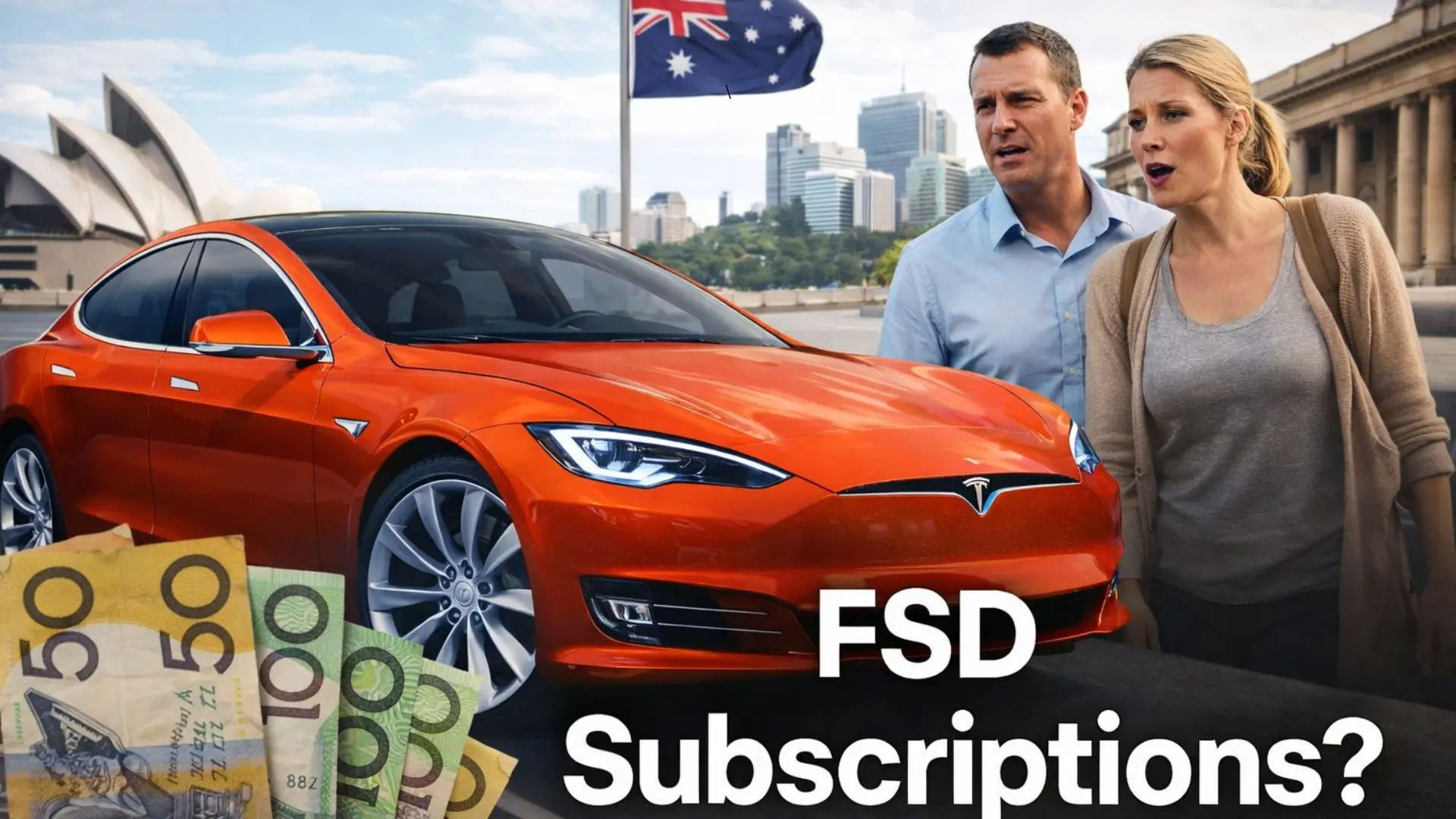
Tesla has confirmed a major change to how Australians — and drivers worldwide — can access its most advanced driver-assistance technology.
From February 14, customers will no longer be able to buy Tesla’s Full Self-Driving (Supervised) software outright. Instead, the feature will only be available through a monthly subscription, according to an announcement by Tesla chief executive Elon Musk on Wednesday.
The move marks a sharp departure from Tesla’s long-standing sales strategy and arrives at a critical moment for the company, as it faces slowing adoption, rising competition, and mounting legal pressure over how Full Self-Driving (FSD) has been marketed.
A Big Shift in Tesla’s Software Strategy
For years, Tesla offered customers two ways to access its Full Self-Driving package: a one-time upfront payment or a monthly subscription.
That option is now being removed.
Musk confirmed in a post on X that Tesla will stop selling FSD as a standalone purchase, though he did not clarify whether the current subscription pricing will change.
The decision reshapes how Tesla monetises one of its most talked-about features — particularly in markets like Australia, where buyers are already navigating high vehicle prices and evolving road safety regulations.
How Tesla Sold FSD Until Now
Tesla’s Full Self-Driving software has never meant hands-off autonomy. Despite the name, the system still requires constant human supervision and does not make a vehicle fully autonomous.
Even so, Tesla has steadily increased the price over time.
The upfront cost peaked at US$15,000 in 2022 before later being reduced to US$8,000. Alongside that, Tesla introduced a subscription model in 2021 at US$199 per month, which was later cut to US$99 per month in 2024.
Musk repeatedly urged customers to buy the software outright, arguing the value would rise sharply as Tesla improved its capabilities.
That message has now been quietly reversed.
Why Tesla May Be Making the Change
Tesla has not publicly explained why it is abandoning the upfront purchase model, but several factors are likely at play.
One is adoption.
In October 2025, Tesla chief financial officer Vaibhav Taneja revealed that only 12% of Tesla customers had paid for Full Self-Driving. That figure fell well short of earlier expectations.
Moving to a subscription-only model lowers the initial cost barrier, which could encourage more drivers to try the feature — especially during a first quarter that analysts expect to be challenging for Tesla’s sales and margins.
The Link to Musk’s $1 Trillion Pay Package
There is also a clear financial incentive tied to Elon Musk personally.
As part of his newly approved pay package, Musk must hit a series of ambitious product targets to unlock the full value — including reaching “10 million active FSD subscriptions,” measured daily over a three-month period, before late 2035.
Read also –Youth Allowance Increase January 2026: $1,011.50 Boost Plus $16.20 Pay Rise
Switching to subscriptions only could make that target more achievable by maximising user numbers rather than relying on high-priced one-off purchases.
Legal Pressure Looms Over FSD Promises
Tesla’s decision may also be shaped by ongoing legal risk.
For nearly a decade, Tesla promoted the idea that its vehicles already contained all the hardware needed to become fully autonomous — with future software updates doing the rest.
That claim has not held up.
Over time, Tesla has had to introduce multiple hardware upgrades. Musk has acknowledged that many owners of vehicles fitted with “Hardware 3” will likely require new hardware before full autonomy becomes possible.
Full Self-Driving was sold under that same promise — that a software update would one day deliver complete autonomy. That milestone has still not been reached.
Regulatory Action and Lawsuits
Tesla’s marketing claims are now under intense scrutiny.
In December, a judge ruled that Tesla engaged in deceptive marketing around both Full Self-Driving and its Autopilot system. The ruling ordered the California Department of Motor Vehicles to suspend Tesla’s manufacturing and dealer licences in the state for 30 days.
While the DMV has stayed the order, Tesla has been given at least 60 days to comply — either by changing the names of the products or delivering software that matches the promises made.
The company also faces several class action lawsuits tied to claims about future autonomous capabilities.
By ending outright FSD purchases, Tesla may be limiting its exposure. Customers on subscriptions pay for ongoing access, not a future guarantee — potentially reducing liability if cases proceed to trial.