

Matt Damon and Ben Affleck have spent decades working inside Hollywood’s traditional studio system. But according to the Oscar-winning duo, the rise of streaming — led by Netflix — has quietly reshaped how movies are made, paced and even written.
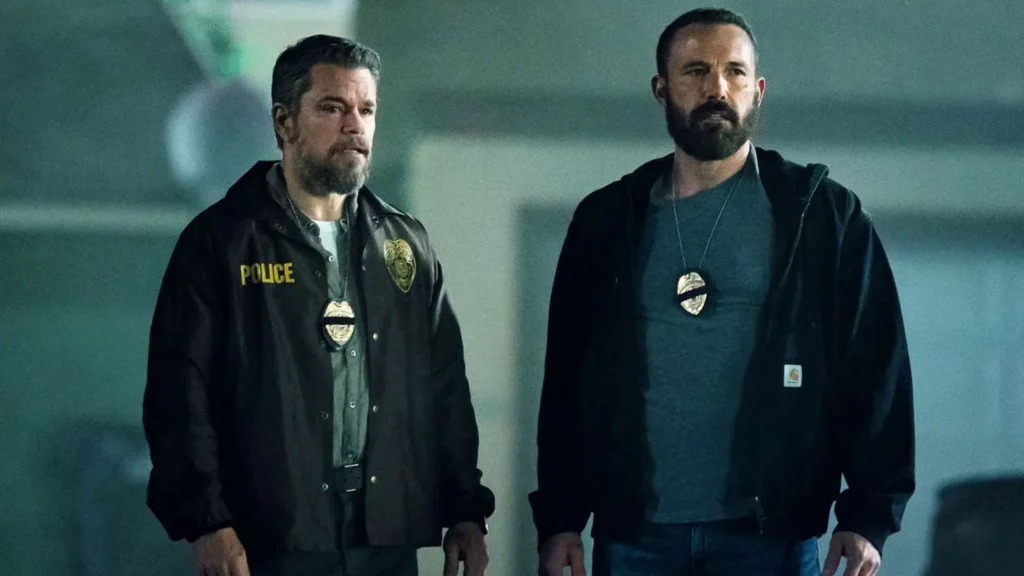
Speaking candidly on The Joe Rogan Experience while promoting their new Netflix film The Rip, Damon and Affleck offered a rare, behind-the-scenes look at how streaming platforms tailor films for audiences watching at home rather than in cinemas.
Their comments shed light on a shift that Australian viewers will instantly recognise: movies now compete not just with each other, but with mobile phones, second screens and constant distractions.
How Streaming Changed the Rules of Filmmaking
During the interview, Damon explained that Netflix approaches storytelling very differently from the classic theatrical model that dominated Hollywood for decades.
Traditionally, action films followed a clear structure. There were usually three major set pieces — one early, one in the middle, and a large, expensive finale that justified the ticket price.
That formula, Damon said, no longer holds the same power in the streaming era.
“The standard way to make an action movie that we learned was, you usually have three set pieces. One in the first act, one in the second, one in the third,” Damon explained, as reported by Variety. “You spend most of your money on that one in the third act. That’s your finale.”
But Netflix, he said, has a different priority.
“And now they’re like, ‘Can we get a big one in the first five minutes? We want people to stay.’”
For streaming platforms, the opening moments matter more than ever. With viewers free to switch content instantly, early engagement has become critical to stopping audiences from clicking away.
Designed for the Living Room, Not the Cinema
Damon’s comments reflect a broader industry reality. Streaming audiences are rarely sitting in dark theatres, fully focused on the screen. They’re at home, often multitasking.
Netflix, according to Damon, actively accounts for that behaviour during development.
He revealed that the platform often encourages filmmakers to repeat key story points in dialogue — not because the story demands it, but because viewers may not be paying full attention.
“‘And it wouldn’t be terrible if you reiterated the plot three or four times in the dialogue because people are on their phones while they’re watching,’” Damon said, quoting studio feedback.
For Australian households juggling busy evenings, it’s a familiar scenario. Films are watched alongside emails, social media and family interruptions — and Netflix appears to be designing content accordingly.
Not Every Netflix Hit Follows the Formula
While Damon outlined the “preferred” approach, both actors were careful to note that Netflix does not force every project into the same mould.
Ben Affleck pointed to a clear counterexample: Adolescence, a Netflix series that recently picked up multiple awards at the Golden Globes.
According to Affleck, the show broke many of the unwritten rules Damon described — and succeeded anyway.
Read also- Netflix’s His & Hers series
“But then you look at Adolescence, and it didn’t do any of that [stuff],” Affleck said. “And it’s [freaking] great.”
Rather than constant action or repeated exposition, the series leans into silence, tension and emotional weight.
“It’s dark too. It’s tragic and intense,” Affleck explained. “This guy finds out his kid is accused of murder. There are long shots of the back of their heads. They get in the car, nobody says anything.”
That kind of storytelling would once have been considered risky in a streaming environment built around instant engagement.
Read also- Batman Film Introduces Two-Face and Raise
Yet Adolescence proved that audiences — including Netflix subscribers — are still willing to sit with slow, challenging material.
A Sign the Audience May Be Changing Too
For Affleck, the success of Adolescence sends an important message to the industry.
He said it demonstrates that filmmakers don’t always need to rely on fast pacing, constant reminders or early explosions to keep viewers invested.
The series’ critical acclaim and awards recognition suggest that even in an era of distraction, there is still room for subtlety and restraint.
Read also- A Knight of the Seven Kingdoms Review: A Smaller, Sharper Journey Through Westeros
That lesson matters for Australian filmmakers and investors watching global streaming trends closely. As platforms continue to shape local production funding and distribution, the balance between creative freedom and algorithm-driven decisions remains a key issue.
What This Means for Viewers and the Industry
Damon and Affleck’s remarks offer rare confirmation of what many viewers have sensed intuitively.
Streaming platforms like Netflix are not just distributing films — they are influencing how stories are structured, how dialogue is written and how quickly action appears on screen.
Read also- Kayce Dutton’s Full Yellowstone Journey — What to Remember Before Marshals
For audiences, it explains why some films feel front-loaded with spectacle or heavy-handed exposition. For creators, it highlights the tension between storytelling tradition and data-driven viewing habits.
At the same time, the success of projects like Adolescence suggests the formula is not fixed. Exceptional storytelling can still break through, even when it ignores the usual streaming playbook.
Read also- Billy Bob Thornton Says Sam Elliott Is “a Dream Come True” — Inside Their 40-Year Bond
As Netflix continues to dominate Australia’s streaming market, these behind-the-scenes insights help explain the evolving shape of modern films — and why the opening five minutes now matter more than ever.
Whether viewers are watching with full attention or half an eye on their phones, the way movies are made has already changed. And as Damon and Affleck make clear, the industry is still working out what comes next.